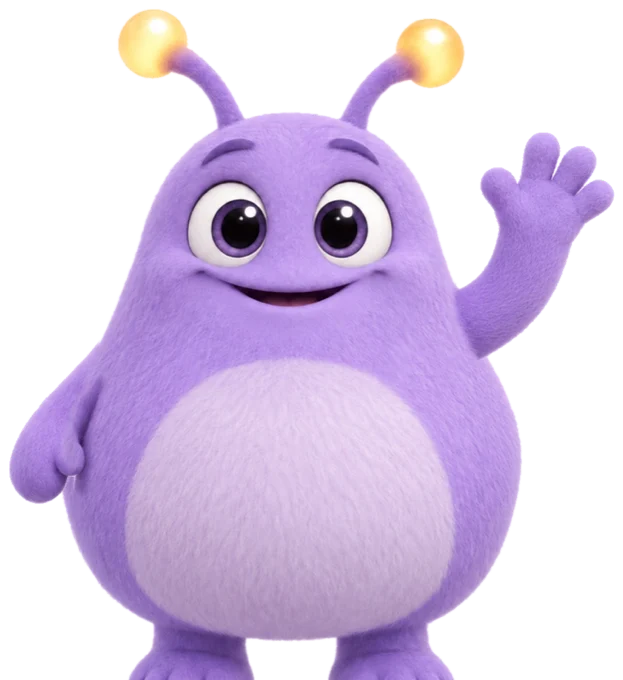
In kindergarten, children work mostly on counting, comparing and small additions and subtractions, plus shapes. Zupzi Math has 12 kindergarten skills on 5 of its 13 islands, covering the first counting, adding and taking away, and shapes, each tied to a Common Core standard, with every question read aloud and Lilo teaching the moment your child gets stuck.
- 12 kindergarten skills
- 5 islands
- 5 hands-on mini-games
- No typing
- Read aloud
- Plays offline
What do kindergartners learn in math?
The Common Core math standards name 2 critical areas for kindergarten:
- Numbers first: counting, comparing groups, and putting together and taking apart small numbers, starting with sets of objects.
- Shapes and space: naming shapes and describing where things are.
The standards add that kindergarten should spend more of its math time on numbers than on anything else. Your child's school or state may use its own version of the standards, and classes move at different speeds. Source: Common Core State Standards for Mathematics, Kindergarten introduction.
The 12 kindergarten skills in Zupzi Math
Grouped by island, each with the Common Core standard it is tied to.
 Counting CoveCounting · 4 skills
- Count to 5
K.CC.B.5 - Count to 10
K.CC.B.5 - Count to 20
K.CC.B.5 - What comes next
K.CC.A.2
 Number BayPlace value · 1 skill
- Which is bigger (to 10)
K.CC.C.7
 Plus PeakAddition · 3 skills
- Add within 5
K.OA.A.5 - Add within 10
K.OA.A.5 - Story problems: joining
K.OA.A.2
 Minus MeadowSubtraction · 3 skills
- Take away within 5
K.OA.A.5 - Take away within 10
K.OA.A.5 - Story problems: taking away
K.OA.A.2
 Shape ShoreShapes and geometry · 1 skill
- Find the shape
K.G.A.2
How kindergartners play
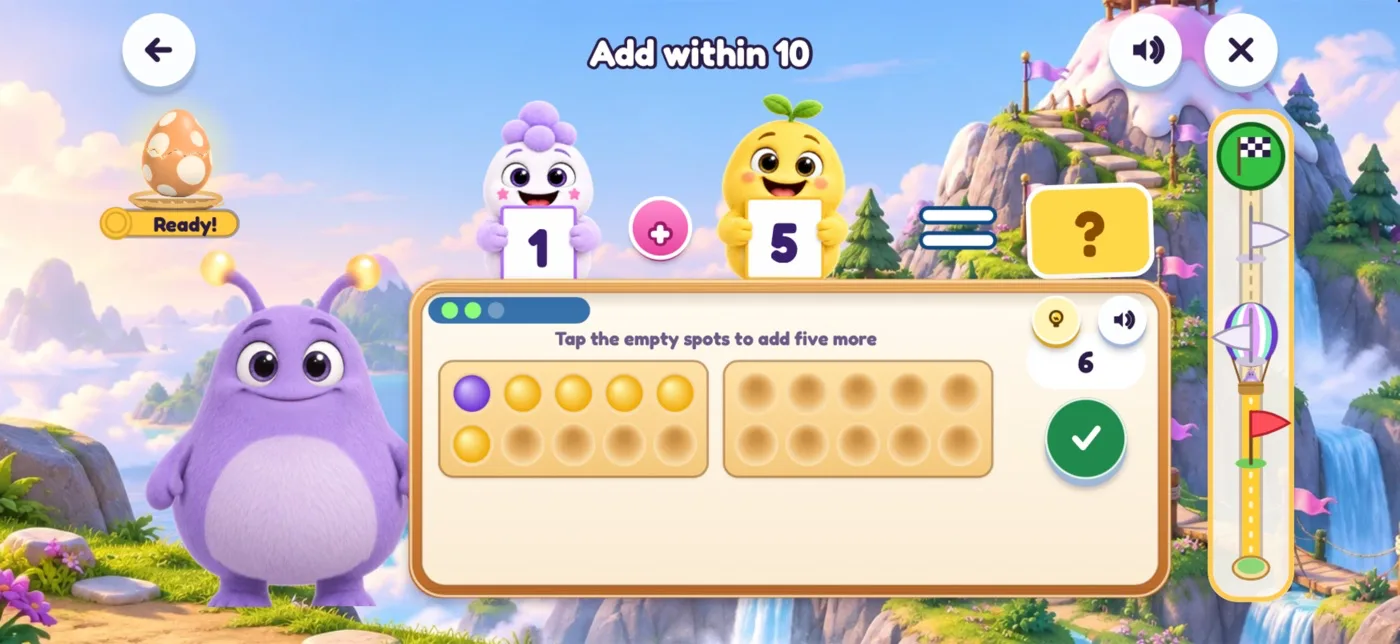
Every question is read aloud, so a child who can't read yet can play. In kindergarten skills the number pad is left out: your child taps, drags and pops instead. Every question is a small scene, never a worksheet, and a new skill starts with Lilo solving one first.
- Bubble Pop: pop the bubble with the right answer.
- Number Line Hop: drag the hopper along a number line to the answer.
- Ten-frame: tap empty spots to add counters, or tap counters to take them away.
- Balance Scale: drag the right weight onto the pan, tap the heavier side, or pick the sign that makes it true.
- Shape Sorter: tap the shape that belongs in the portal.
Where your child starts
The first time your child opens the game, a short placement quiz of at most eight questions finds the right grade. If you added your child's birthday, it starts at the grade the birthday suggests (the usual U.S. rule: kindergarten for children who turn 5 by September 1); without one, and on a child's own paired iPad or iPhone, it starts at 1st grade. It moves up while your child answers right and down while they miss, until it finds where they are. You can retake it from Grown-ups and pick the grade it starts at.
What you see as a grown-up
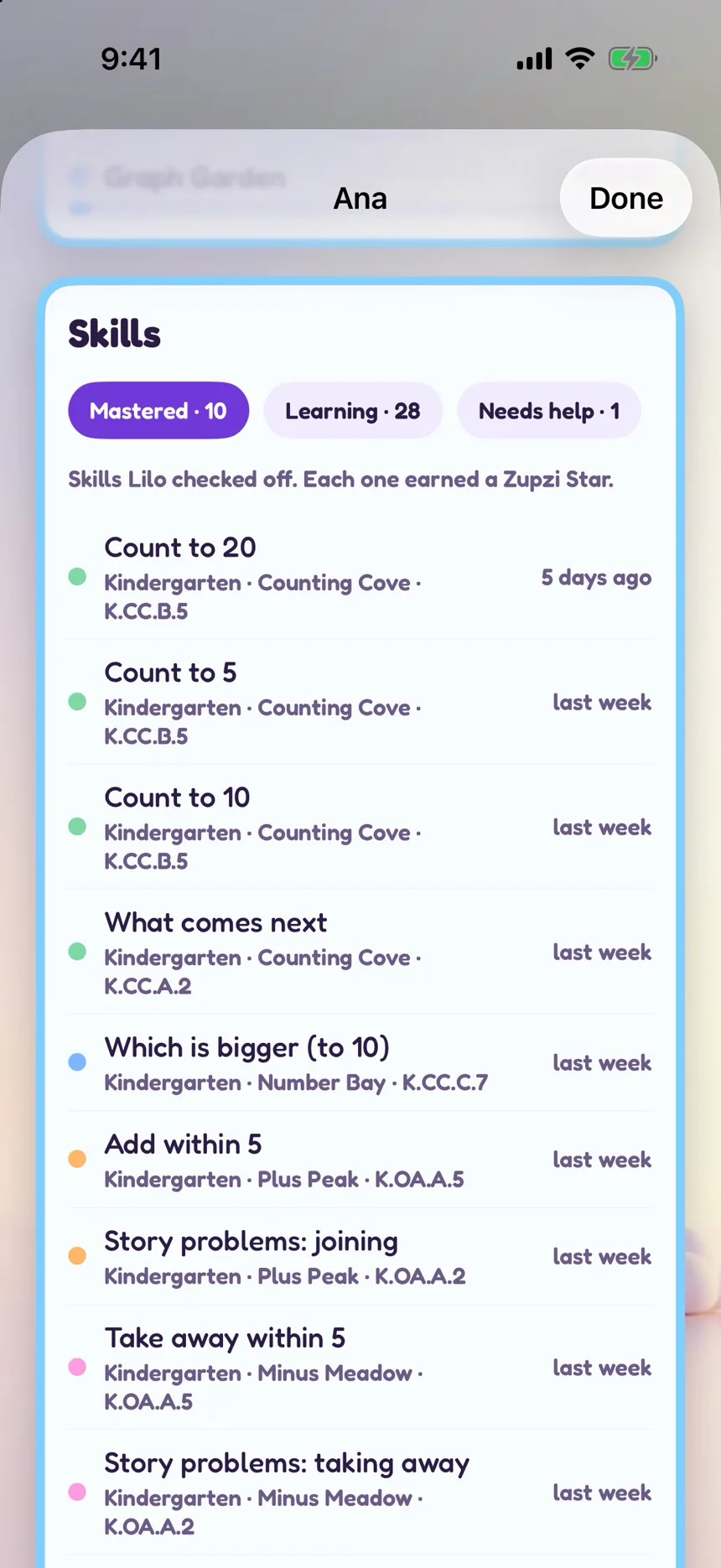
Under Grown-ups, each child has a Progress report: skills mastered out of 158, minutes this week, and tabs for Mastered, Learning, Needs help and Review due, with the Common Core code beside every skill. On days your child plays, the grown-ups in the family get a short e-mail; on Sundays it covers the week, and on the 1st the month.
Questions about kindergarten math
What kindergarten math does Zupzi Math cover?
12 skills: Counting Cove: Count to 5, Count to 10, Count to 20 and What comes next; Number Bay: Which is bigger (to 10); Plus Peak: Add within 5, Add within 10 and Story problems: joining; Minus Meadow: Take away within 5, Take away within 10 and Story problems: taking away; Shape Shore: Find the shape. Each one is tied to a Common Core standard, shown in the Progress report.
How does a kindergartner answer questions in Zupzi Math?
By tapping, dragging and popping: in kindergarten skills the number pad is left out. The mini-games in the kindergarten skills are Bubble Pop, Number Line Hop, Ten-frame, Balance Scale and Shape Sorter.
What if my child is ahead of or behind kindergarten?
The placement quiz finds your child's grade whatever their age, so a kindergartner who is ahead starts in 1st grade or above. Kindergarten is where Zupzi Math begins, so a child who needs more time simply stays there, and the next visit brings a missed skill back easier. Skills from grades below the one they place in start as mastered, and the grade just below comes back as review. After that, each skill moves up a level when your child gets five of the last six right in a reasonable time, and eases off after three misses in a row.
Can my kindergartner play if they can't read yet?
Yes. Every question, hint and lesson is read aloud, and in lessons each sentence shows as a caption with the word being said lit up. In kindergarten skills the number pad is left out: your child taps, drags and pops instead. The short written instructions above some mini-games are not read aloud.
More in Zupzi Math
Other grades:
Or explore by topic, island by island:
 Clock Tower
 Coin Market
 Ruler Ridge
 Times Farm
 Share Harbor
 Pizza Point
 Tile Town
 Graph Garden